Nano Bonds on Short and Fine Hair: What’s Possible and What to Expect
Contents:
- Why this question matters
- The basics: what nano bonds are
- Nano versus micro and standard
- What is possible on short hair
- Minimum length
- What you can realistically add
- What is not possible
- Permanent options for short hair
- What is possible on fine hair
- How the fitting goes
- What to expect afterwards
- Costs, plainly
- Advanced nuances
- Mixed bond sizes
- Hair that is fine and damaged
- Growing out a short cut
- Scalp sensitivity
- Who nano bonds suit, and who should wait
- Good candidates
- Better to wait
- Realistic examples
- The pixie that is growing out
- Fine hair that never grew
- The cautious first-timer
- Myths about nano bonds on fine and short hair
- “Fine hair cannot take extensions”
- “Nano bonds fall out quickly”
- “They will thin my own hair”
- “Short hair means no extensions”
- A calendar for short and fine hair
- Budget plans: how to keep it sensible
- Nano bonds versus tape-ins, a commonly confused alternative
- The sustainability angle
- Differences across the UK
- Choosing a salon for nano bonds
- Care routine for nano bonds on fine hair
- Washing
- Drying
- Brushing
- Sleeping
- Styling
- Common mistakes to avoid
- FAQ
- Do nano bonds damage fine hair?
- How short can my hair be for nano bonds?
- How long do nano bonds last?
- Can I tie my hair up?
- Are nano bonds worth the extra cost?
Can nano bonds really work on short and fine hair, or is that a promise made by people who sell extensions? The honest answer is that they can, within limits that are easy to understand. This guide sets out what is possible, what is not, how the fitting goes and what to check before you pay a deposit, so you buy the right thing the first time.
Why this question matters
Short and fine hair is the hardest case in the extension world. Short hair gives the stylist less to hold on to. Fine hair cannot carry much weight. Put them together and the room for error shrinks to almost nothing. A large bond, an overloaded set or a rushed fitting can turn a good idea into a thin patch, a tangle or a bond that slides off in a week. That is why the choice of method, and the person doing the fitting, matters more here than anywhere else.
The basics: what nano bonds are
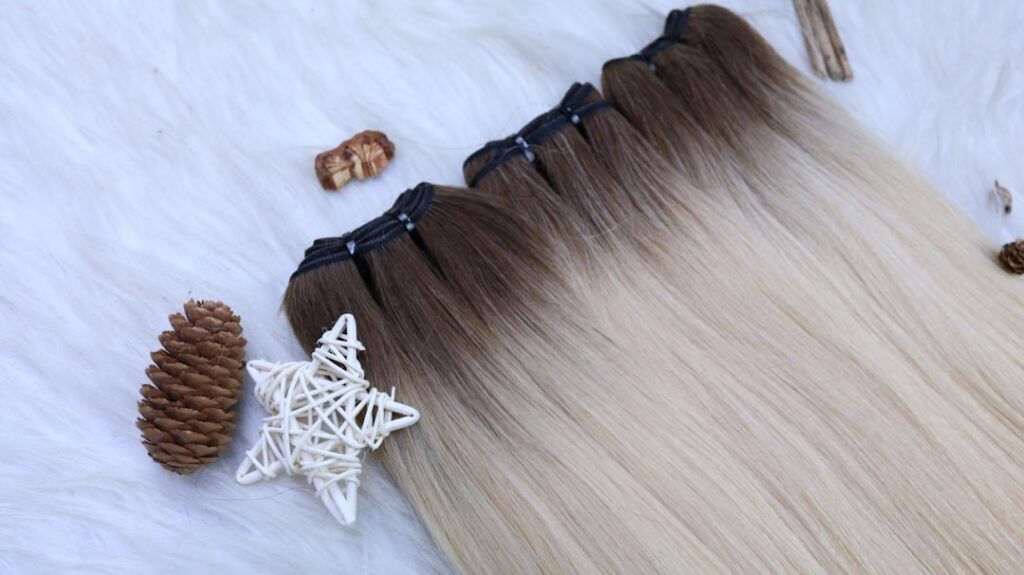
A nano bond is the smallest keratin bond used for hair extensions. Each extension strand is attached to a small section of your own hair with a tiny tip of keratin, which is warmed, pressed and rolled flat. Because the bond is so small, it weighs very little and is hard to see. The trade-off is that you need more bonds to reach the same density, so fitting takes longer. If you want to see how the method is applied in more detail, the page on nano bond hair extensions sets out the approach and who it suits.
Nano versus micro and standard
- Standard bonds: the largest and strongest. Best for thick hair and long extensions. Visible on fine hair.
- Micro bonds: smaller and lighter. A good middle choice for medium hair.
- Nano bonds: the smallest and lightest. The usual choice for fine, thin or short hair.
What is possible on short hair
Minimum length
There is no universal minimum, because it depends on the strength of your hair, the bond size and the stylist’s method. As a general guide, many stylists want around three to four inches of your own hair to place a bond securely, and nano bonds can sometimes be placed on slightly less. Hair shorter than that is usually better grown out or extended in stages. A consultation is the only reliable way to find out.
What you can realistically add
- Length: a few inches at a time. Jumping from a crop to shoulder length in one go usually looks unnatural and puts strain on short hair.
- Density: extra fullness at the crown, sides or ends, with a light set of nano bonds.
- Shape: help with growing out a cut, such as a pixie or a short bob, by filling in the shorter areas.
What is not possible
Nano bonds cannot turn a very short crop into long hair overnight, and they cannot hold weight that fine strands cannot carry. If a salon promises either, look elsewhere.
Permanent options for short hair
If you are looking at permanent hair extensions for short hair, the word “permanent” is relative. Bonded extensions stay in for weeks to months, and are removed professionally. They are not permanent in the way a haircut is. The page for short hair explains how the salon approaches lengths that others turn away.
What is possible on fine hair
Fine hair describes the width of each strand, not the number of strands. You can have fine hair that is dense, or thick-looking hair that is made of very fine strands. Both behave differently from coarse hair when you add extensions.
- Weight is the limit. A fine strand can carry only so much, which is why bonds are small and the quantity is modest.
- Placement matters. Bonds are kept away from the thinnest areas, such as the hairline and temples, and spaced so that no strand carries too much.
- Less is often more. A light set of nano bonds can give a visible lift without straining the hair.
How the fitting goes
- Consultation. The stylist checks your hair length, strand thickness, density and scalp. They will often pull a few strands to test strength.
- Shade and texture matching. In daylight, against your hair at the roots and ends.
- Quantity decision. A modest number of strands, with room to add later.
- Sectioning. Thin sections, staggered, working from the nape upwards.
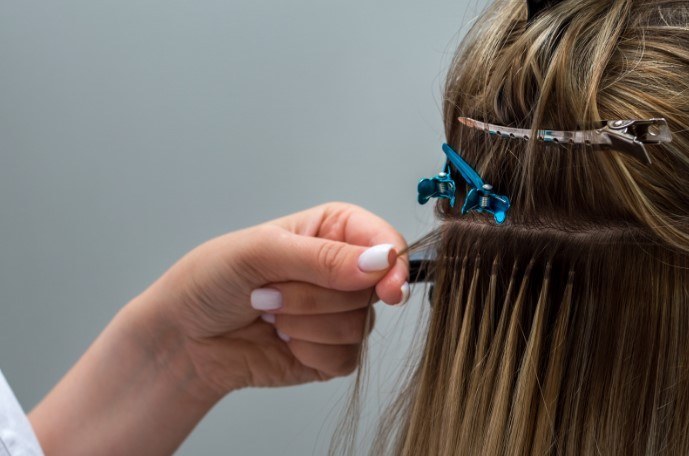
- Bonding. Each nano bond is placed a few millimetres from the scalp, and rolled flat around a very small section of hair.
- Cutting and blending. The extension hair is cut to match your shape.
- Aftercare briefing. You leave with instructions, products to avoid and a date for the first move-up.
A full head of nano bonds can take four to six hours, longer than larger bonds. That is the price of invisibility, and a good reason to plan the day.
What to expect afterwards
- First days: mild tension as the scalp adjusts. It should ease within two to three days.
- First weeks: you will settle into a washing and brushing routine. Expect a little shedding of your own hair, visible in the bonds.
- Eight to ten weeks: the bonds will have moved down as your hair grows. This is the time for a move-up.
- Beyond: with regular maintenance and good hair, the same set can often be reused.
Costs, plainly
Nano bond fittings usually cost more than larger bonds because of the time involved, even though less hair may be needed. Prices vary by salon and hair quality, so treat these as orientation and ask for written quotes.
- Hair: a modest quantity of good Remy hair, priced by length.
- Fitting: several hours of skilled work, often the largest part of the cost.
- Maintenance: a move-up every eight to ten weeks, priced below the first fitting.
- Home care: a sulphate-free shampoo, a loop brush and a satin pillowcase.
The way to keep costs sensible is to start light, buy good hair that can be reused and keep every maintenance appointment.
Advanced nuances
Mixed bond sizes
Many heads of hair are not uniform. The nape and hairline are often finer than the crown. A skilled stylist may use nano bonds in the finest areas and micro bonds elsewhere, which gives invisibility where it matters and holding power where it counts.
Hair that is fine and damaged
If your hair is fine and recently bleached or over-processed, extensions are not the answer yet. Rest, repair and a trim come first. Any stylist who fits extensions onto visibly fragile hair without a conversation is selling a short-term look.
Growing out a short cut
Many clients use nano bonds as a bridge while their hair grows. A staged approach, adding length gradually and moving up as the hair grows, is gentler than one big change, and it looks more natural at each stage.
Scalp sensitivity
Nano bonds are the usual answer for sensitive scalps, because they carry the least weight. If you have a history of traction hair loss or scalp conditions, tell the stylist at the start.
Who nano bonds suit, and who should wait
Ivana Farisei recommends this check before any nano bond fitting, and it is worth running yourself first.
Good candidates
- You have fine hair that is healthy, with no recent heavy bleaching or chemical straightening.
- You have a short cut and a growing-out plan, with a few inches of length to work with.
- You want to tie your hair up without the bonds showing.
- You can commit to a maintenance appointment every eight to ten weeks.
Better to wait
- Your hair is breaking, thinning rapidly or recently damaged. Repair and rest first.
- Your scalp is sore, inflamed or showing signs of a condition. See a doctor or trichologist.
- Your hair is shorter than the minimum the stylist can work with. A trim and a few months of growth may help.
- You want a result without any upkeep. No bonded method offers that.
Realistic examples
The pixie that is growing out
Hannah, a physiotherapist in Leeds, had a pixie cut that she wanted to grow into a bob. At three inches, her hair was at the lower limit, and the stylist advised a staged plan: a light set of nano bonds placed at the back and sides to add two inches, then a move-up with extra length after ten weeks. By month five, her hair sat at a smooth bob and nobody saw the join.
Fine hair that never grew
Mei, a software tester in Southampton, has very fine, straight hair that stalls just below her shoulders and looks wispy at the ends. A modest set of nano bonds at the ends and lower layers gave her a fuller, longer look without any weight at the roots. She wears a high ponytail to work and says nobody has ever seen a bond.
The cautious first-timer
Olivia, a student in Glasgow, was nervous about damage. At the consultation, the stylist tested her strand strength, suggested a very light density and put a rest period in the plan. Her first set was small, and she added more at the first move-up once she was confident. These examples are illustrative, but they follow how real plans are made: start light, stage the length and keep the schedule.
Myths about nano bonds on fine and short hair
“Fine hair cannot take extensions”
It can, when the bond is small, the quantity is light and the hair is healthy. The limit is weight, not thinness.
“Nano bonds fall out quickly”
A well-fitted nano bond holds as well as larger ones on fine hair, since it matches the strength of the strand. Slipping usually points to damp roots, heavy products near the bond or a skipped maintenance appointment.
“They will thin my own hair”
Shed hair builds up inside the bonds over weeks, and it comes out at removal, which can look like loss. If your hair was healthy and the bonds were light, density returns to normal.
“Short hair means no extensions”
Short hair can have extensions if there is enough length to hold a bond. Staging the length makes it possible for many cuts.
A calendar for short and fine hair
- January and February: dry air and hats. Use a richer conditioner and a silk-lined hat.
- March to May: a good window for a first fitting, with mild weather.
- June to August: sun and chlorine. Protect fine ends and rinse after swimming.
- September and October: a sensible time for a move-up before the festive season.
- November and December: party styling means more heat. Keep a brush in your bag and book early.
Budget plans: how to keep it sensible
Fine and short hair does not need a large set, which helps. A modest quantity of good hair, a careful fitting and a regular schedule is the most cost-effective route. Many people begin with a light set, check how the hair responds and add more at the first move-up. That approach costs less than over-filling the head, and it protects your own strands. The honest salons, Ivana Farisei among them, would rather fit fewer strands well than sell a large set that your hair cannot carry.
It is also worth asking at the first consultation what the total cycle costs: the hair, the fitting, two or three maintenance appointments and removal. A written breakdown makes it easy to compare Ivana Farisei with any other salon on the same terms.
Nano bonds versus tape-ins, a commonly confused alternative
Many people compare nano bonds with tape-in extensions, because both are aimed at fine hair and both are seen as lightweight. They are different in important ways.
- Attachment: nano bonds attach individual strands with keratin tips, while tape-ins sandwich a section of hair between adhesive strips.
- Visibility: nano bonds are tiny and spread across the head. Tape-in strips are flat but wider, and show when hair is tied up.
- Weight distribution: nano bonds spread the load across many strands. Tape-ins concentrate it along each strip.
- Time: tape-ins are quicker to fit. Nano bonds take longer.
- Styling: nano bonds allow ponytails and updos with less visibility.
For very fine or short hair, most stylists lean towards nano bonds, though tape-ins can suit some fine, straight hair worn down. Ask the stylist to explain their reasons.
The sustainability angle
Extensions can be a relatively low-waste choice if used well. Individually bonded strands can be removed and refitted, so good hair can be used several times, which reduces the number of sets you buy. A few habits help.
- Buy once, buy well. Good hair that lasts is better than cheap hair replaced every few months.
- Reuse where possible. Ask whether the hair can be rebonded.
- Ask about sourcing. A transparent salon can tell you where the hair comes from.
- Wash less. Two or three washes a week saves water and protects the bonds.
- Choose concentrated products. Smaller bottles and fewer chemicals.
Differences across the UK
Where you live changes what a stylist advises. In London and the South East, hard water leaves a mineral film on fine hair that makes it limp, so a clarifying wash or shower filter helps. In the North and Midlands, damp, cooler weather means static and frizz, so moisture matters. In Scotland and Wales, soft water is kind to fine hair, but wind makes tangling at the nape more likely. If you are searching for hair extensions near me, remember that a specialist who understands short and fine hair is worth a train journey.
Choosing a salon for nano bonds
- Do you fit nano bonds regularly, and on short hair?
- Can I see photos of clients with fine or short hair?
- What is the minimum length you will work with?
- How many strands will you recommend, and why?
- What is included in the quote?
- How is removal done?
Ivana Farisei answers these questions before booking, and the consultation looks at strand thickness and length first, not the price list. In my experience, that is where short and fine hair clients get the best advice: the team will tell you when to wait, and will map a staged plan for growing out. Ivana Farisei also offers dedicated pages and services for nano bonds, short hair, removal and re-fitting, which makes the whole cycle easy to plan.
Care routine for nano bonds on fine hair
Washing
Two to three times a week with a sulphate-free shampoo. Keep conditioner away from the bonds.
Drying
Dry the roots fully. Use a cool or low-heat setting.
Brushing
A loop brush, from the ends upwards, holding the hair above the bond.
Sleeping
A loose plait and a satin pillowcase.
Styling
A heat protectant, and tools kept at least two fingers away from the bonds.
Common mistakes to avoid
- Choosing bonds that are too large. They show and pull on fine hair.
- Adding too many strands. Fine hair cannot carry heavy loads.
- Trying to go from very short to long at once. Stage the length.
- Skipping maintenance. Bonds move down and tangle.
- Using heavy oils near the bonds. They loosen the hold.
- Booking on price alone. A rushed fitting costs more later.
FAQ
Do nano bonds damage fine hair?
Properly fitted on healthy hair, they are among the gentlest bonded options. Damage usually comes from too much weight, poor removal or neglected maintenance.
How short can my hair be for nano bonds?
Often around three to four inches, sometimes less, depending on strength and the stylist’s method. A consultation will confirm.
How long do nano bonds last?
Bonds need a move-up every eight to ten weeks, and good hair can often be reused.
Can I tie my hair up?
Yes. Nano bonds are the least visible, so ponytails and updos are usually possible, within sense.
Are nano bonds worth the extra cost?
For fine or short hair, usually yes, because the comfort and finish are noticeably better. For thick hair, you may be paying for something you will not notice.